Museum
Team
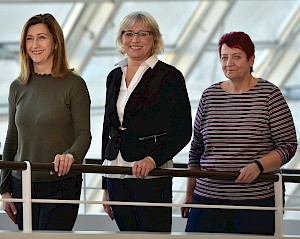
We’re here for you! The museum team
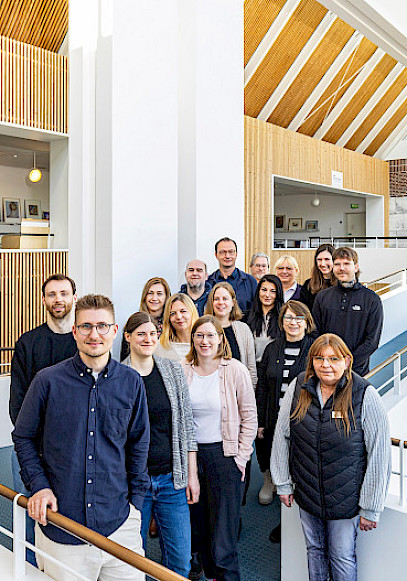 © GLM, Foto: Thorsten Hübner
 MANAGEMENT
Director
Thomas Schmäschke
Tel: +49 (0)2381 17-5700
Thomas.Schmaeschke@Stadt.Hamm.de

Deputy Director
Jalina Tschernig, M.A.
Tel: +49 (0)2381 17-5731
Jalina.Tschernig@Stadt.Hamm.de

Deputy Director
Ronja Friedrichs, M.A.
Tel: +49 (0)2381 17-5703
Ronja.Friedrichs@Stadt.Hamm.de
ADMINISTRATION
Head of Administration
Lars Gödecker
Tel: +49 (0)2381 17-5706
Goedecker@Stadt.Hamm.de
Deputy Head of Administration
Dr Katharina Müller-Kinne
Tel: 02381 17-5730
Katharina.Mueller-Kinne@Stadt.Hamm.de

Accounting
Janin Pröhl-Rostalski
Tel: 02381 17-5701
Janin.Proehl@Stadt.Hamm.de
COLLECTION
Egyptian Collection
Jalina Tschernig, M.A.
Tel: +49 (0)2381 17-5731
Jalina.Tschernig@Stadt.Hamm.de

City and Regional History Collection
Kathinka Engels, M.Sc.
Tel: +49 (0)2381 17-5735
Kathinka.Engels@Stadt.Hamm.de

Research Fellowship Programme for Art Museums in NRW I Collection Research
Daniel Hübner
Tel: +49 (0)2381 17-5707
Daniel.Huebner@Stadt.Hamm.de
Fine Art Collection | Applied Art Collection | Prints and Drawings Collection
Ronja Friedrichs, M.A.
Tel: +49 (0)2381 17-5703
Ronja.Friedrichs@Stadt.Hamm.de

PRESS & PUBLIC RELATIONS
COMMUNICATION & MARKETING
Dr Katharina Müller-Kinne
Tel: +49 (0)2381 17-5730
Katharina.Mueller-Kinne@Stadt.Hamm.de

EDUCATION AND MEDIATION
Head
Alexandra Peter, M.A.
Tel: +49 (0)2381 17-5704
Alexandra.Peter@Stadt.Hamm.de

Daniela Krellmann
Tel: 02381 17-5711
Daniela.Krellmann@Stadt.Hamm.de
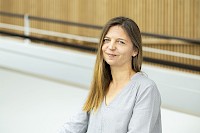
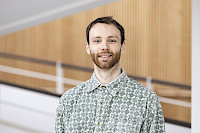
Research Fellowship Programme for Art Museums in NRW I Education & Mediation
Aron Schmidtke
Tel: +49 (0)2381 17-5722
Aron.Schmidtke@Stadt.Hamm.de
CONSERVATION
Michael Bottländer
Tel: +49 (0)2381 17-5727
Michael.Bottlaender@Stadt.Hamm.de

STORAGE MANAGEMENT
Dr Christin Schulte
Tel: +49 (0)2381 17-5733
Christin.Schulte@Stadt.Hamm.de

BUILDINGS SERVICES
Hans Engelmann
Tel: +49 (0)2381 17-5712
Tel: +49 (0)171 3027923
Engelmann@Stadt.Hamm.de
museumstechnik@Stadt.Hamm.de
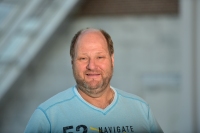
Dirk Neuhaus
Tel: +49 (0)2381 17-5710
Tel: +49 (0)163 4812735
museumstechnik@Stadt.Hamm.de
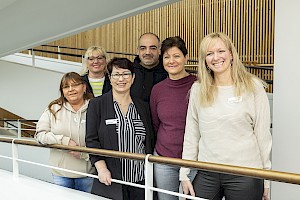
VISITOR SERVICES
Tel: +49 (0)2381 17-5714
Museumskasse@Stadt.Hamm.de
JOB VACANCIES
Unfortunately, we do not have any job openings posted at the moment.
HISTORY OF THE MUSEUM
Milestones in the History of the Collections
The collections of the Gustav-Lübcke-Museum have a long history, tracing back to an initiative by the Museumsverein, which was founded in 1886 by a group of distinguished gentlemen from the town’s bourgeoisie. While the Museumverein’s interest in collecting was initially focused on the ‘history of the immediate vicinity’, its acquisition policy has since changed considerably. Today, the focus of the collection is on objects spanning various periods from the fields of art and crafts, Egyptian cultural history, archaeology and city history.
The museum is named after a local resident, Gustav Lübcke (1868–1925), who was born in Hamm. He learned the craft of bookbinding and devoted himself to collecting art, antiques and coins. Lübcke found happiness in Düsseldorf, where he met and fell in love with the art dealer Therese Nüsser (1848–1930). During the First World War, the couple sought a safe and permanent home for the treasures they had collected together.
Under a contract dated 3 April 1917, they bequeathed their vast collection of arts and crafts to the town of Hamm. That same year, Therese and Gustav Lübcke moved to Hamm, where Gustav Lübcke became the museum’s first full-time director. Since then, the museum has borne the name of its generous benefactor.
While the museum’s collections were forced to relocate repeatedly during the first few decades, in 1927 they were finally given their own premises in the newly built town hall, thus freeing them from dependence on the private rental market. Here, Ludwig Bänfer, Lübcke’s successor as museum director, presented not only historical exhibitions but also contemporary art from Hamm and the surrounding region. Bänfer was also actively involved in the field of prehistory and early history; in doing so, he rode the wave of the National Socialists’ revaluation of prehistory: the Nazis sought to prove the superior value of the ‘Germanic race’. The museum faced a major challenge when, towards the end of the war, almost all the objects in the collection had to be moved to numerous different locations to protect them from bomb damage – and then returned after the war ended.
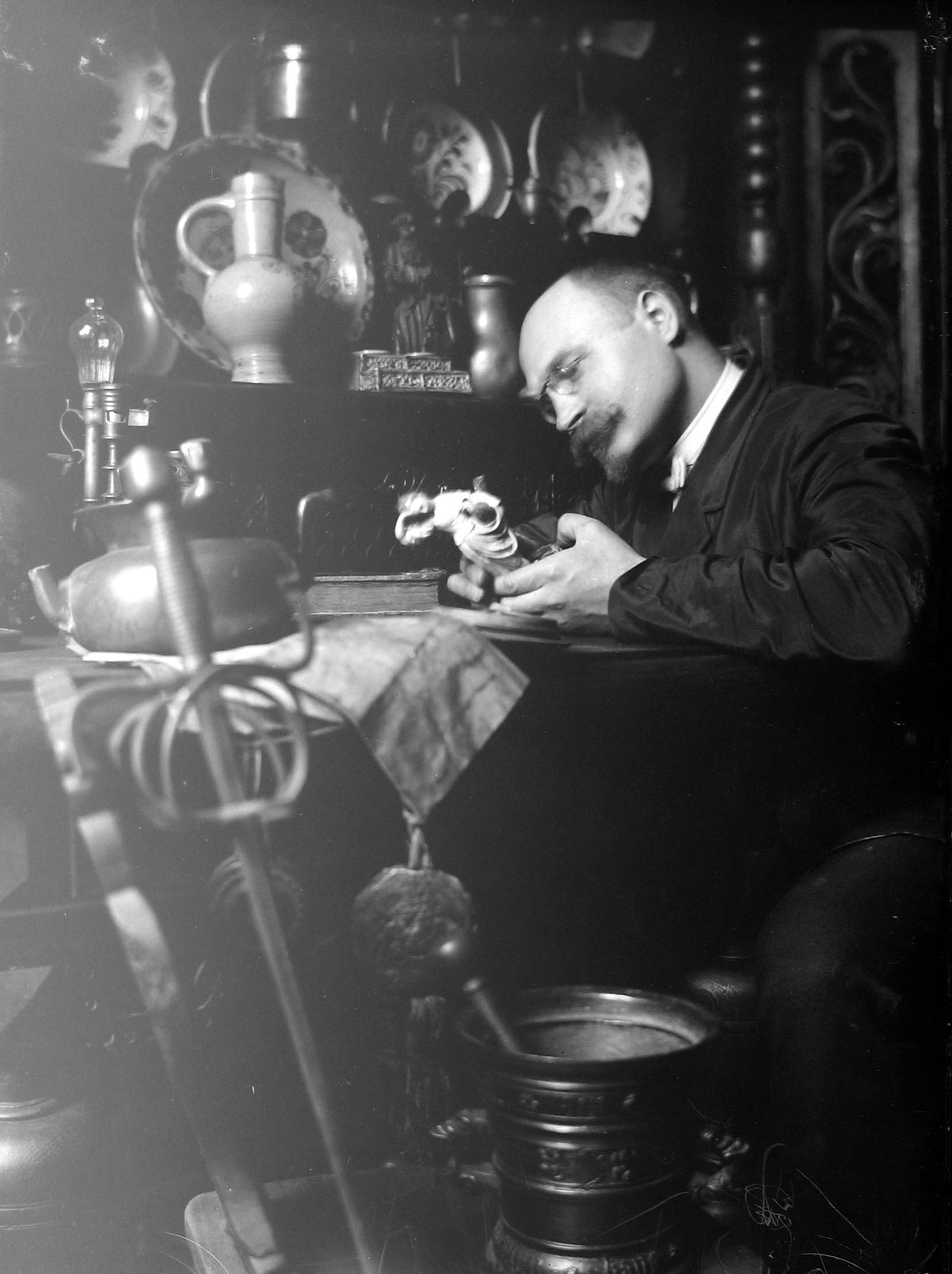 Gustav Lübcke bei der Begutachtung seiner Schätze, Bildbearbeitung © Heinz Feußner, Hamm
 In the decades following 1945, the museum’s holdings were expanded primarily through the addition of works of fine and applied art; in the 1980s and 1990s, this was particularly marked by works of the Informel movement. The collections also grew steadily through donations and acquisitions in the museum’s other departments, which made the question of suitable museum accommodation increasingly pressing. The new museum building, which opened in 1993, allowed the collections to be presented with clear structures and organised according to scholarly criteria. Alongside fine and applied art, as well as ancient Egyptian cultural history, the museum now also featured sections on the history of the city, prehistory and early history, and numismatics.
Today, the Gustav-Lübcke-Museum displays the objects it has collected since 1886 across an area of more than 4,000 square metres and regularly stages changing exhibitions that attract visitors from far and wide.
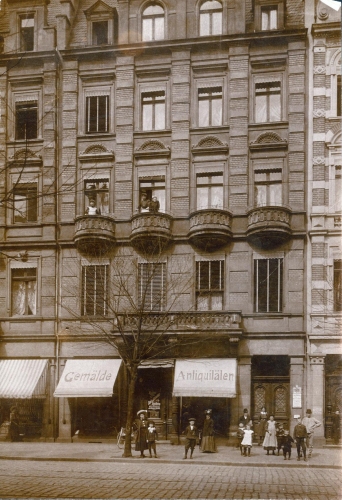 Kunst- und Antiquitätengeschäft von Therese und Gustav Lübcke in Düsseldorf, Kaiser-Wilhelm-Straße 18, Bildbearbeitung © Heinz Feußner, Hamm
 ARCHITECTURE
In 1993, the new building for the Gustav-Lübcke-Museum, designed by Jørgen Bo and Vilhelm Wohlert, was inaugurated. The Danish architectural firm had already made a name for itself in 1958 with the construction of the Louisiana Museum of Modern Art in Humlebæk near Copenhagen. The architects continued to develop the fundamental architectural concept evident in that building in subsequent projects such as the Kunstmuseum Bochum and the Gustav-Lübcke-Museum. Overall, the architecture captivates with its light-filled spaces, dynamic visual axes and variously sized and shaped rooms.
‘Whenever we were entrusted with the design of museums, the exhibits in the collections were always of paramount importance to us. We have no interest in self-aggrandising architecture; rather, we have always sought to create a fruitful dialogue between the architectural framework and the works of art on display.’
Jørgen Bo and Vilhelm Wohlert, 1998
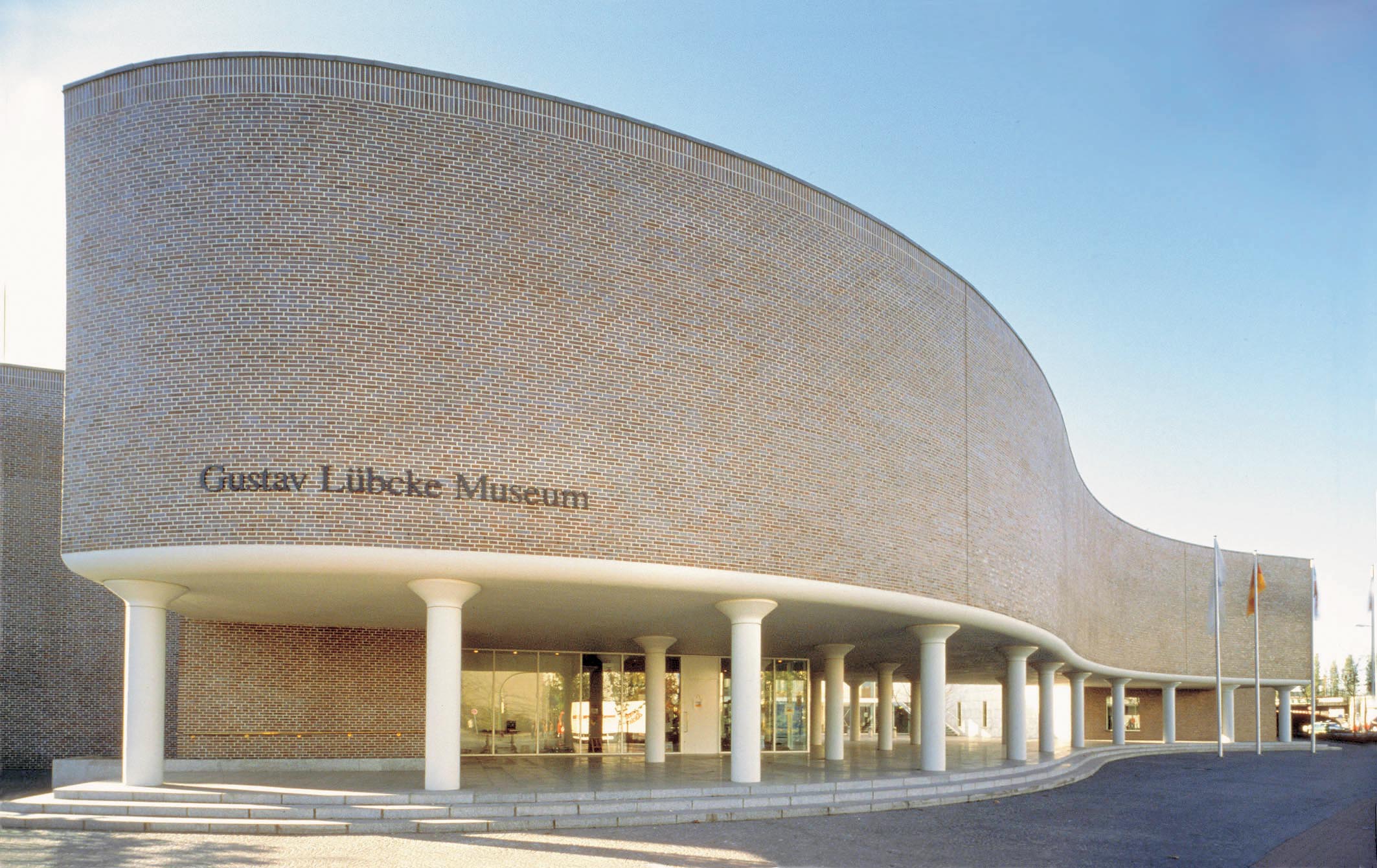 © Heinz Feußner
 The curved external façade, with its red-violet brick walls, has a striking appearance that sets it apart from the surrounding buildings. White columns support the curved wing, forming a kind of passageway that leads into the museum’s inner courtyard. Walking through it creates a natural distance from the hustle and bustle of traffic, without completely blocking it out. The museum is part of the dynamic urban landscape yet opens up a world of its own to visitors. Both the front and the roof of the foyer are glazed, offering a clear view into the interior of the museum. The connection to the outside world is deliberately maintained.
Upon entering the museum, the first thing that catches the eye is the large ascending ramp, which invites visitors to explore the spacious foyer from a wide variety of perspectives. The architecture itself thus becomes an experience in its own right. The exhibition rooms exude an atmospheric ambience that is modern, spacious and inviting. The Skylight Hall, where major special exhibitions are presented, is particularly notable for its remarkable sense of space.
The museum’s distinctive architecture is visible and engages in dialogue with the diverse collections of the Gustav-Lübcke-Museum, while always allowing visitors to experience the aura of the original undisturbed.
Restaurierung
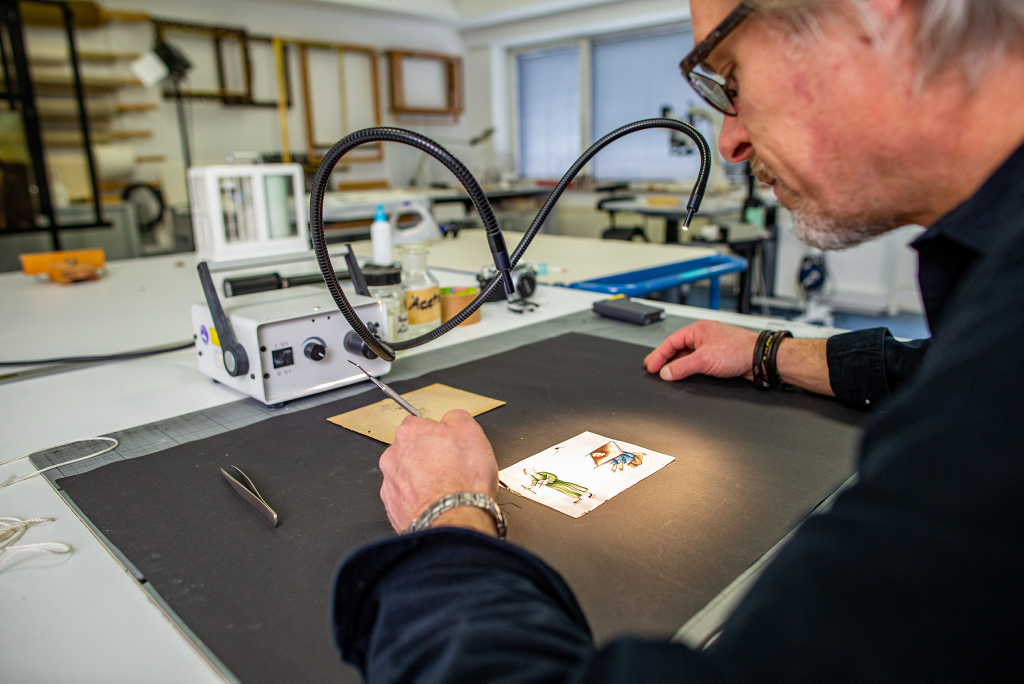 Michael Bottländer in seiner Werkstatt © Thorsten Hübner
 MUSEUMSVEREIN
The Museumsverein dates back to the very beginning of the Gustav-Lübcke-Museum’s history. When it was founded on 3 March 1886, the collection consisted mainly of objects relating to local and regional history. Just one year later, however, a special artefact arrived here from a remote cultural region: in 1887, the Hamm Mummy Society, which had been established for this specific purpose, handed over a genuine Egyptian mummy to the Museumsverein Hamm. Although the mummy was lost during the Second World War, the Egyptian collection continued to grow steadily and now comprises more than 1,000 objects. In 1917, the holdings finally passed into municipal ownership. The Museumsverein still exists today, though its remit and purpose have changed.
A museum needs friends!
The Museumsverein Hamm is now the association of friends of the Gustav-Lübcke-Museum. It supports the museum’s work in various areas. With its help, the museum is able to acquire important objects for the collection. Complex restorations of exhibits can also be carried out thanks to its support. Furthermore, promoting the museum’s educational outreach is a stated aim of the association’s financial commitment. Thanks to its support, the museum is made accessible to children and young people in particular through selected programmes. Furthermore, many special additional activities are made possible thanks to its backing.
Members of the Museumsverein enjoy special benefits
- Free admission to the permanent exhibitions at the Gustav-Lübcke-Museum
- Free admission to the special exhibitions at the Gustav-Lübcke-Museum
- Exclusive guided tours for association members during major special exhibitions
- Discounts on additional activities, such as talks and special events
- Opportunities to take part in exclusively organised excursions
- All children or grandchildren of association members under the age of 18 receive a free membership card
- Free delivery of the museum’s programmes
Members recruit members: As a token of gratitude, you will be given a discount voucher for the museum shop (20% off).
Membership fees per calendar year
- Individual membership €30.00
- Membership plus (2 people) €40.00
- Concessionary individual membership €10.00
- Corporate membership €150.00
Further information can be found on the Museumsverein website
RUHRKUNSTMUSEEN
21 MUSEUMS, 16 CITIES, MORE THAN 130 ART EXHIBITIONS A YEAR!
The RuhrKunstMuseen represent a unique museum landscape and an outstanding concentration of modern art, spanning from the nineteenth century through the modern era to the present day.

In no other cultural landscape are the past and new beginnings, industrial history and the cultural present, everyday life and fine art so closely intertwined as in the Ruhr region. Here, a coherent network of world-class collections stretches across the region, housed in industrial buildings, castles, outstanding post-war architecture and spectacular new buildings.
For more than ten years, they/we have been working together, with the RuhrKunstMuseen – now numbering twenty-one member museums – presenting around 130 art exhibitions each year spanning an area of 45,000 square metres in sixteen cities across the Ruhr region. The catalyst for this collaboration was the RUHR.2010 European Capital of Culture year.
Highlighting the multifaceted museum landscape of the Ruhr Metropolis, drawing the attention of art enthusiasts to the region’s concentrated cultural scene and attracting culture lovers to the region – these are, among others, the tasks to which the network is dedicated through its combined efforts. Joint exhibition projects such as CHINA 8 (2015) and Kunst & Kohle (Art & Coal, 2018) generate significant appeal and contribute to the wider recognition of the Ruhr region as a cultural hub. Locally, the RuhrKunstMuseen are active through cross-city outreach projects such as the RuhrKulturWalks.
The RuhrKultur.Card brings together thirty-two museums, eleven RuhrBühnen theatres and five festival partners, showcasing the exciting, cross-city cultural offerings in the Ruhr Metropolis.
The RuhrKultur.Card has also been expanded to include a further category: ‘Cultural Treasures’. These include, among others, the Essen Cathedral Treasury, the Zollverein UNESCO World Heritage Site with the Ruhr Museum and the Portal of Industrial Culture, the German Mining Museum in Bochum, the Gasometer in Oberhausen and other partners. The Cultural Treasures offer a wide variety of exhibition formats on a diverse range of topics, thereby providing fascinating insights into the region’s cultural landscape.
Holders of the RuhrKultur.Card can enjoy a full year’s worth of cultural events for 49 euros, including one-off free admission to all twenty-one RuhrKunstMuseen and all partners in the Cultural Treasures category, a 50 per cent discount on tickets for any of the eleven RuhrBühnen theatres, and at the cultural festivals International Short Film Festival Oberhausen, the Ruhrfestspiele in Recklinghausen, the Ruhr Triennale, the Klavier-Festival Ruhr and the Mülheimer Theatertage NRW ‘Stücke’!
The RuhrKultur.Card is now complemented by the free ‘ruhrkultur.jetzt’ web app. This replaces the printed guide. The online travel guide provides information on the RuhrKunstMuseen and the RuhrBühnen, the participating festivals and the new Cultural Treasures: www.ruhrkultur.jetzt.
The web app also features a daily updated cultural calendar of exhibitions, theatre productions and other events. And with the integrated GPS navigation, everyone can find their way across the Ruhr cultural region. There are also highlights in the categories ‘must-see’, ‘food & drink’, ‘accommodation’ and ‘also worth a visit’, as well as tours curated by cultural insiders.
Further information can be found at www.ruhrkunstmuseen.com.
